Advisory for clients and developers
We stand alongside you at every stage of your project — from choosing the optimal heat generation to selecting equipment. So that you can decide rather than guess.
At a glance
Client advisory at 38 Grad Gebäudetechnik supports developers and owners through every building services decision in a project: the choice of heat generation system, option appraisal with capital and operating costs, equipment and system selection, and compliance with the energy legislation of the Canton of Zurich.
- Typical triggers: heating replacement, refurbishment decision, new build, property acquisition, regulatory notice
- Output: option comparison with life-cycle costs, recommendation and implementation roadmap
- Legal framework: Zurich Energy Act, Besondere Bauverordnung I, MuKEn
A construction project is a series of decisions
We understand that a building project demands many decisions and brings a range of challenges with it.
Choosing the right heat generation is decisive for comfort, operating cost and efficiency — and today it is inseparable from energy law. In the Canton of Zurich, replacing a heat generator requires renewable energy where this is technically feasible and adds no more than five per cent over the life cycle.
The range of equipment on the market can be overwhelming. We rank the options against the criteria that actually matter for your property: available space, noise protection, the flow temperature the existing distribution system requires, water protection, consentability, and the question of what will still be maintainable in twenty years.
The result is not a catalogue but a recommendation — reasoned, supported by numbers, and written so that you can defend it in an owners' meeting or before a board.
What we actually deliver
Option comparison with life-cycle costs
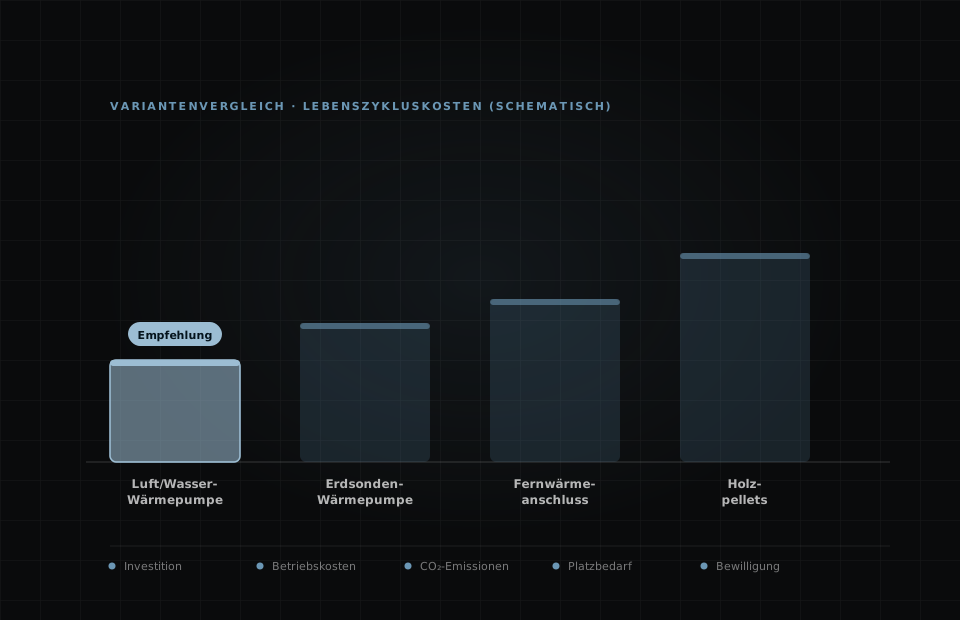
Air-to-water heat pump, ground-source borehole, groundwater, district heating or biomass — compared on capital cost, operating cost, carbon and consenting effort.
Heat generation and system selection
Sizing of the generation concept including storage, domestic hot water strategy, flow temperatures and required changes to the existing distribution.
Equipment and manufacturer selection
Independent assessment of plant and components on output, acoustics, maintainability, spare parts availability and service life.
Subsidies and consents
Review of current subsidy contributions, preparation of notification and permit procedures, acoustic assessment for air-to-water heat pumps.
Programme and phasing
Realistic planning of lead times, delivery periods and construction sequence — critical for occupied properties and for heating replacement ahead of the heating season.
Support in governance meetings
Decision papers prepared for condominium meetings, foundation and supervisory boards — clear and ready to decide on.
Why choose us?
Advice across the whole system
We look beyond the plant itself at the interplay of building, use, law and commercial viability.
Engineering depth
Practical experience from new build and existing stock — including the awkward questions that otherwise surface too late on site.
One named contact
A fixed point of contact who knows your property. No ticket numbers, no rotating team.
Frequently asked questions about client advisory
Can an oil boiler still be replaced with another oil boiler in the Canton of Zurich?
In principle, no. Under the revised Zurich Energy Act, replacing a heat generator in an existing building requires renewable energy where this is technically feasible and adds no more than 5 % over the life cycle. Where that test demonstrably fails, a fossil system remains permissible — but 10 % of energy consumption must then be saved or supplied renewably.
By when must electric heating be replaced?
Fixed electric resistance heating used for space heating, and central water heaters running exclusively on electricity, must be replaced in the Canton of Zurich by 2030. The legal basis is § 45c of the Besondere Bauverordnung I, in force since 1 September 2022. Defined exceptions apply, for example emergency heating, decentralised bathroom and WC heating, systems up to 3 kW or under 50 m² of heated area.
How large are the subsidies for replacing a heating system?
The Canton of Zurich made around CHF 61 million available for its 2025 subsidy programme. From January 2025 base contributions for replacing fossil heating were cut by roughly a third while output-related contributions were increased, favouring systems above 30 kilowatts. Replacing decentralised electric or fossil heating attracts an additional contribution of at least CHF 15,000 towards heat distribution. Subsidy levels change annually — we check the current position for your property.
Does a heat pump require planning permission?
Since 1 January 2023 many heat pumps in the Canton of Zurich can be installed under a simplified notification procedure rather than a full permit. Air-to-water heat pumps always require a noise assessment as part of the application. Ground-source boreholes additionally require a water-protection permit from the canton and are not covered by the notification procedure.
Should the building envelope be upgraded before replacing the heating?
Not necessarily, but the sequence materially affects sizing. Insulating first means a smaller and cheaper heat generator afterwards. What matters most is that a planned envelope upgrade is already reflected in the heat load calculation. Otherwise the heat pump is oversized and runs permanently in inefficient cycling.
What does a heating replacement feasibility study deliver?
It systematically tests which heat generation is actually viable at your location — air-to-water heat pump, ground-source borehole, groundwater, district heating or biomass. It accounts for available space, noise protection, water protection, the existing distribution system and the required flow temperatures. The output is an option comparison with capital and operating costs.
Is district heating preferable to an individual system?
It depends on the location. Where a heat network exists or is planned, connection is often the simplest solution. In the Canton of Zurich a heat network connection is permissible where at least 70 % of the heat is generated without CO₂ emissions from fossil fuels. The decision should follow a life-cycle cost comparison rather than capital cost alone.
Let's talk about your project.
Tell us about your building and we will come back within 24 hours with an initial technical assessment — free of charge and without obligation.