Energy consulting for building services
We are your partner for tailored solutions that improve energy efficiency and sustainability — from analysis through strategy to implementation.
At a glance
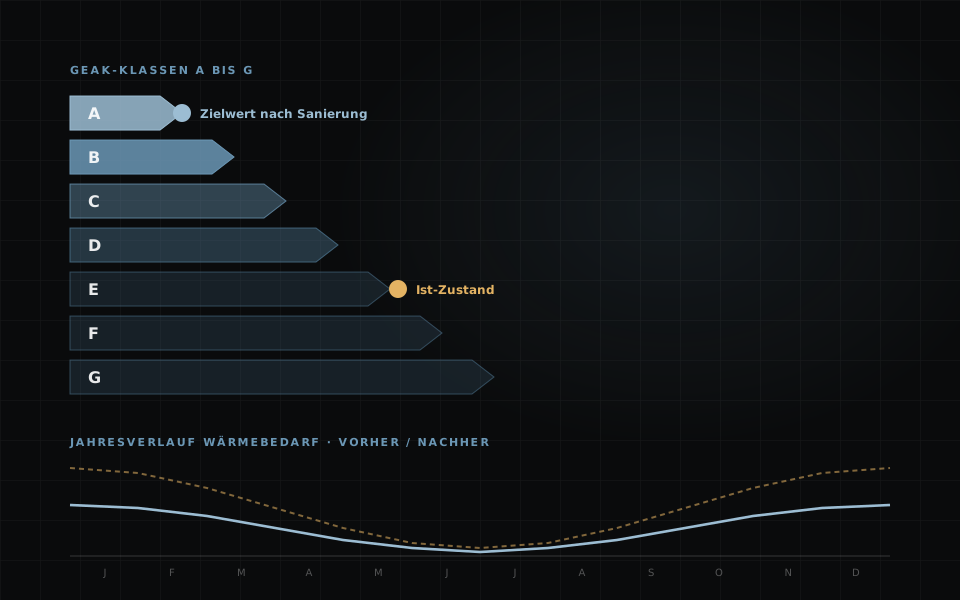
Energy consulting at 38 Grad Gebäudetechnik links the energy assessment of a building to a concrete implementation path: consumption analysis, GEAK classification, option modelling, subsidy review and prioritisation of measures by effect per franc invested.
- Instruments: GEAK and GEAK Plus, statutory energy verification, Minergie, operational optimisation, monitoring
- Framework: Zurich Energy Act, MuKEn 2025, federal and cantonal net-zero targets
- Output: prioritised action plan with costs, savings and available subsidies
From analysis to effective action
Our energy consulting offers a range of services to improve efficiency and sustainability in building services.
Based on the results of our analyses we develop strategies and concepts that reduce your energy costs. What counts for us is not the most spectacular measure but the most effective one: a properly executed operational optimisation frequently delivers more than a costly new investment — and it is available immediately.
Our advice concentrates on sustainable solutions that offer more than short-term gains and contribute to environmental protection over the long run. Buildings account for around 40 per cent of Swiss energy consumption; every kilowatt-hour saved keeps working for decades.
We also place measures within the regulatory roadmap. Knowing which deadlines apply to a property allows investment to be bundled instead of erecting scaffolding twice.
What we actually deliver
Consumption and condition analysis
Evaluation of energy purchases and operating data, benchmark comparison, identification of the largest sources of loss.
GEAK and GEAK Plus
Energy classification from A to G and an advisory report with refurbishment options — in many cases a prerequisite for subsidies.
Subsidies and viability
Review of cantonal and municipal programmes, payback calculation, life-cycle cost assessment.
Decarbonisation pathway
A roadmap for replacing fossil heat generation, aligned with deadlines, use and available budget.
Innovative strategies
Waste heat recovery, photovoltaic self-consumption, storage management, low-temperature concepts and adaptation of the heat distribution.
Implementation and monitoring
Support during delivery and monitoring of actual performance across at least one heating season.
Why choose us?
Sustainable by design
We optimise for twenty years of operation, not for the brochure.
Numbers, not intuition
Every recommendation carries savings, investment and payback — traceable enough for any owners' meeting.
Regulatory certainty
We know the requirements in the Canton of Zurich and design so that your investment survives the next legislative revision.
Frequently asked questions about energy consulting
What is the GEAK and when do I need one?
The GEAK (Gebäudeenergieausweis der Kantone) is the Swiss cantonal building energy certificate. It rates a building's overall energy performance and direct CO₂ emissions on a scale from A to G. The GEAK Plus adds an advisory report with concrete refurbishment options and is a prerequisite for subsidies in many cantons. As at the end of 2025 around 207,100 buildings in Switzerland held a GEAK.
What changes with MuKEn 2025?
The Conference of Cantonal Energy Directors adopted the model energy regulations of the cantons (MuKEn 2025) on 29 August 2025. New provisions include limits on embodied greenhouse gas emissions for new buildings, a photovoltaic obligation on suitable roof areas during comprehensive refurbishment, and the requirement that from 2050 no heating system may run on fossil fuels. The provisions become binding only once transposed into the respective cantonal law.
How does Minergie differ from the statutory standard?
The statutory minimum is defined by cantonal energy regulations and the energy verification. Minergie is a voluntary, more demanding building standard with certification, adding requirements for the envelope, controlled ventilation, renewable energy and solar use. Around 61,900 buildings in Switzerland are provisionally or definitively Minergie-certified.
How much does operational optimisation achieve?
In existing plant, control parameters, operating times and setpoints have often never been revisited even though use has changed. Operational optimisation corrects this without physical intervention and therefore usually offers the best ratio of effort to effect. It relies on monitoring actual consumption and operating data across at least one heating season.
Why does hydraulic balancing matter so much?
Without hydraulic balancing some circuits are over-supplied and others starved, which drives up flow temperatures and depresses seasonal performance factors. With heat pumps every degree of flow temperature has a measurable effect on electricity consumption. Balancing is therefore not optional fine-tuning but a precondition for economic operation.
Let's talk about your project.
Tell us about your building and we will come back within 24 hours with an initial technical assessment — free of charge and without obligation.